
Preparing the Request JWT 2 min read
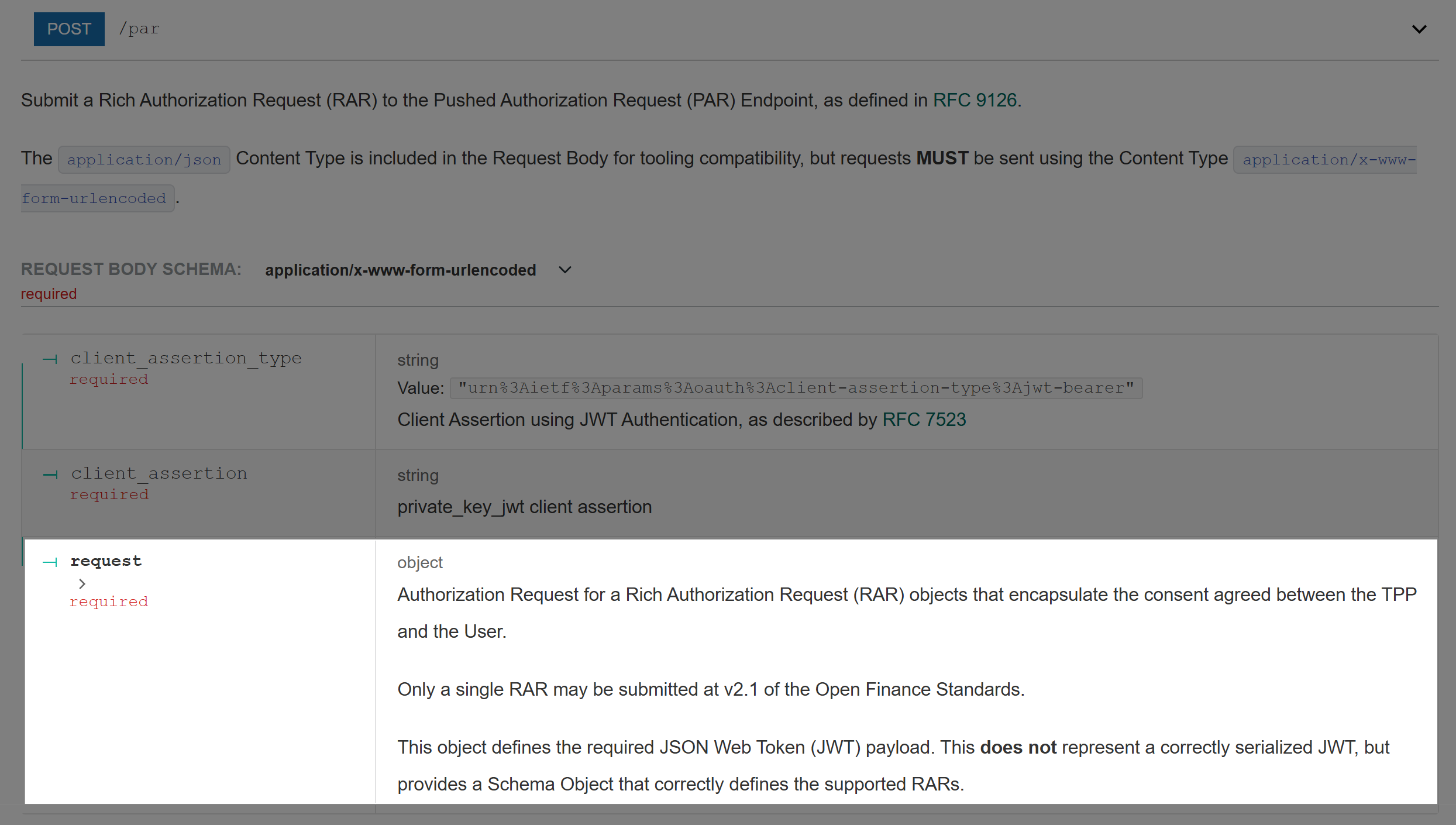
To send a /par request, you must first construct a signed Request JWT (also called a Request Object or JAR — JWT Authorization Request). This JWT is a signed package of all authorization parameters, proving they came from your registered application and haven't been tampered with.
For a precise per-claim reference covering aud, exp/nbf lifetime windows, clock skew, and the difference between the Request Object and Client Assertion, see JWT Claim Rules.
JOSE header — algorithm and signing key
{
  "alg": "PS256",
  "kid": "<your-signing-key-id>"
}| Field | Value | Description |
|---|---|---|
alg | PS256 | Signing algorithm — RSA-PSS with SHA-256 |
kid | string | Key ID of your signing certificate, as registered in the Trust Framework |
Authorization parameters carried inside the signed JWT
| Claim | Type | Required | Description | Example |
|---|---|---|---|---|
aud | string | ✓ | The issuer of the Authorization Server — found via API Discovery | https://auth1.[LFICode].apihub.openfinance.ae |
iat | number | ✓ | Issued At Unix timestamp — when the JWT was created | 1713196113 |
exp | number | ✓ | Expiry as a Unix timestamp. Must be shortly after nbf — maximum 5 minutes | 1713196423 |
iss | string | ✓ | Your application's Client ID from the Trust Framework | your-client-id |
client_id | string | ✓ | Your application's Client ID (same as iss) | your-client-id |
redirect_uri | string | ✓ | The callback URI registered in your Trust Framework application | https://yourapp.com/callback |
scope | string | ✓ | Space-separated OAuth 2.0 scopes | accounts openid |
nonce | string | ✓ | Random UUID — prevents replay attacks by binding the ID token to this request | a1b2c3d4-... |
state | string | ✓ | Random UUID — returned in the redirect; prevents CSRF attacks | e5f6g7h8-... |
nbf | number | ✓ | Not Before Unix timestamp. Set slightly before iat (e.g. iat - 10) to allow for clock skew | 1713196103 |
response_type | string | ✓ | Must be code | code |
code_challenge_method | string | ✓ | PKCE method — only S256 is supported | S256 |
code_challenge | string | ✓ | Base64url-encoded SHA-256 hash of your code_verifier | E9Melhoa2Ow... |
max_age | number | Maximum age (seconds) of the user's existing authentication session. Capped at 3600 | 3600 | |
authorization_details | array | ✓ | Describes what the user is consenting to — see Consent | [{...}] |
Generating a PKCE code challenge
Before building the JWT, generate a code_verifier and derive the code_challenge from it:
import crypto from 'node:crypto'

// Generate a cryptographically random code_verifier (43–128 chars, URL-safe)
export function generateCodeVerifier(): string {
  return crypto.randomBytes(32).toString('base64url')
}

// Derive the code_challenge (S256 = SHA-256 of the verifier, base64url-encoded)
export function deriveCodeChallenge(verifier: string): string {
  return crypto.createHash('sha256').update(verifier).digest('base64url')
}
Store the code_verifier securely — you'll need it when exchanging the authorization code for tokens.
Assemble and sign the JWT in code
import { SignJWT, importPKCS8 } from 'jose'
import { readFileSync } from 'node:fs'
import crypto from 'node:crypto'

const ALGORITHM   = 'PS256'
const KEY_ID      = process.env.SIGNING_KEY_ID!
const CLIENT_ID   = process.env.CLIENT_ID!
const ISSUER      = process.env.AUTHORIZATION_SERVER_ISSUER!  // from .well-known
const REDIRECT_URI = process.env.REDIRECT_URI!

const privateKey = await importPKCS8(
  readFileSync('./certificates/signing.key', 'utf8'),
  ALGORITHM
)

interface RequestJWTOptions {
  scope: string
  codeChallenge: string
  authorizationDetails: unknown[]
  maxAge?: number
}

export async function buildRequestJWT({
  scope,
  codeChallenge,
  authorizationDetails,
  maxAge = 3600,
}: RequestJWTOptions): Promise<string> {
  const now = Math.floor(Date.now() / 1000)

  return new SignJWT({
    // Authorization Server identity
    aud: ISSUER,

    // Client identity
    iss: CLIENT_ID,
    client_id: CLIENT_ID,

    // Authorization parameters
    scope,
    redirect_uri: REDIRECT_URI,
    response_type: 'code',

    // PKCE
    code_challenge_method: 'S256',
    code_challenge: codeChallenge,

    // Security
    nonce: crypto.randomUUID(),
    state: crypto.randomUUID(),
    max_age: maxAge,

    // Consent
    authorization_details: authorizationDetails,

    // Timing
    iat: now,
    nbf: now - 10,
    exp: now + 300,  // 5-minute expiry
  })
    .setProtectedHeader({ alg: ALGORITHM, kid: KEY_ID })
    .sign(privateKey)
}End-to-end PAR submission and redirect
import { generateCodeVerifier, deriveCodeChallenge } from './pkce'
import { buildRequestJWT } from './request-jwt'

// 1. Generate PKCE pair
const codeVerifier  = generateCodeVerifier()
const codeChallenge = deriveCodeChallenge(codeVerifier)

// 2. Build the authorization_details (example: bank data sharing consent)
const authorizationDetails = [
  {
    type: 'urn:openfinanceuae:account-access-consent:v2.1',
    consent: {
      ConsentId: crypto.randomUUID(),
      ExpirationDateTime: new Date(Date.now() + 364 * 24 * 60 * 60 * 1000).toISOString(),
      Permissions: ['ReadAccountsBasic', 'ReadBalances', 'ReadTransactionsBasic'],
      OpenFinanceBilling: {
        UserType: 'Retail',
        Purpose: 'AccountAggregation',
      },
    },
  },
]

// 3. Build and sign the Request JWT
const requestJWT = await buildRequestJWT({
  scope: 'accounts openid',
  codeChallenge,
  authorizationDetails,
})

// 4. Send to /par
// Endpoints are read from .well-known/openid-configuration —
// not constructed from the issuer URL (they live on different hosts).
const response = await fetch(discoveryDoc.pushed_authorization_request_endpoint, {
  method: 'POST',
  headers: {
    'Content-Type': 'application/x-www-form-urlencoded',
  },
  body: new URLSearchParams({ request: requestJWT }),
})
const { request_uri, expires_in } = await response.json()

// 5. Redirect the user
const authorizeUrl = new URL(discoveryDoc.authorization_endpoint)
authorizeUrl.searchParams.set('client_id', CLIENT_ID)
authorizeUrl.searchParams.set('request_uri', request_uri)
window.location.href = authorizeUrl.toString()Store codeVerifier in your session — you'll need it at the /token endpoint to exchange the authorization code for access tokens.
The pii field inside payment consents is itself a JWE
For payment consents, the consent's PII payload (creditor and debtor names, account numbers, and related personal data) must be encrypted with the LFI's public encryption key and carried as a JWE in the consent's pii field — nested inside authorization_details within this Request JWT. The Request JWT itself is signed (JWS) but is not wrapped in a JWE; only the pii field is.
This keeps the PII end-to-end encrypted: the API Hub routes the consent without being able to read the personal data, and only the LFI — holder of the private key — can decrypt and validate it. See Message Encryption for how to produce the JWE, and Payment PII Encryption for the rationale and validation responsibilities.