Keys and Certificates 4 min read
To operate within the ecosystem, your application must use certificates issued and stored within the Trust Framework. There are three types of certificates, each serving a distinct security function.
Transport and Signing — both required for LFI clients
As an LFI, you are required to create two certificate types per application:
1. Transport Certificate — Required
Used for mutual TLS (mTLS) to authenticate your client (application) when making API requests.
- Purpose: Secure transport and client authentication
- Usage: mTLS handshake for all API calls
- Presented to: API providers during connection
2. Signing Certificate — Required
Used to digitally sign JWTs your application sends — such as client assertions, request objects, etc.
- Purpose: Proving integrity and authenticity of signed payloads
- Usage: Signing the contents of JWTs
The Trust Framework also supports an Encryption Certificate, but this is not required for LFI clients. Note that the encryption keys you may see on your organisation (e.g. ENC1) are server-side keys used by the platform — these are distinct from application-level encryption certificates. An application-level encryption certificate is only needed by TPPs that wish to receive encrypted webhook event notifications. See Webhooks for more information.
Each certificate plays a critical role in securing communication and asserting identity. Once you understand the certificate types, you can generate the required keys and CSRs according to the Trust Framework specifications.
2048-bit RSA, SHA-256 CSR, and the required subject fields
Keys and certificates within the Trust Framework (TF) must meet the following requirements:
- 2048-bit RSA private key (unencrypted)
- A corresponding Certificate Signing Request (CSR) signed with SHA-256
- CSR subject fields must include:
- C → Country — must be set to
AE(United Arab Emirates) - O → Organization — must equal the Organization's legal name in the Trust Framework
- OU → Organizational Unit — must equal the Organization's ID in the Trust Framework
- CN → Common Name — must equal the application's Client ID (the UUID assigned by the Trust Framework when the application was created)
- C → Country — must be set to
Generating the Private Key and CSR
The Trust Framework provides an example using OpenSSL to generate:
- A private key file (
.key) - A Certificate Signing Request file (
.csr)
Example:
openssl req -new -newkey rsa:2048 -nodes \
  -keyout <UUID>.key \
  -out <UUID>.csr \
  -subj "/C=AE/O=<LegalName>/OU=<OrganizationId>/CN=<UUID>" \
  -sha256
Replace LegalName and OrganizationId with your organisation's details from the Trust Framework. Replace UUID with your application's Client ID — the UUID assigned when the application was created (see Creating an Application). Equivalent cryptographic tools may be used, provided all requirements above are met.
The .csr file (Certificate Signing Request) must be uploaded to the Trust Framework. The .key file (Private Key) must be kept secure and must never be shared. More information on private key handling and security requirements can be found here.
Creating a certificate in the Trust Framework portal
Navigate to App Certificates
- Open your application in the Trust Framework.
- Click App Certificates.
- Click + New Certificate.
Select the certificate type
- Select Transport or Signing. You will need to repeat this process for each. Do not create an Encryption certificate for your LFI client.
Generate the private key and CSR
- Generate your private key (
.key) and Certificate Signing Request (.csr). - Confirm that the CSR has been generated successfully before proceeding.
Production environmentsThe OpenSSL command shown is intended for demonstration and testing only. In production, private key generation and CSR creation must be performed within your HSM or equivalent secure key management infrastructure, in accordance with your institution's security policies.
- Generate your private key (
Upload the CSR
- Click Upload your CSR and select the
.csrfile generated in the previous step.
- Click Upload your CSR and select the
Download the certificate
- Once the Trust Framework processes the CSR, your certificate is ready. Download the
.pemcertificate file. - You now have the
.pem/.keypair. Store your private key securely — it must never be shared. See Secure Management for requirements.
- Once the Trust Framework processes the CSR, your certificate is ready. Download the
Certificates are valid for 13 months and must be rotated before they expire to avoid breaking services. You only rotate the certificates whose private key you hold — Nebras rotates the rest. See Certificate Rotation for the best-practice guide covering reminders, the safe overlap pattern, and transport- and signing-specific steps.
The kid value used in every signed JWT
Once your certificate is issued, the Trust Framework assigns it a Key ID (kid). This value must be included in the kid header of every JWT signed with the corresponding private key.
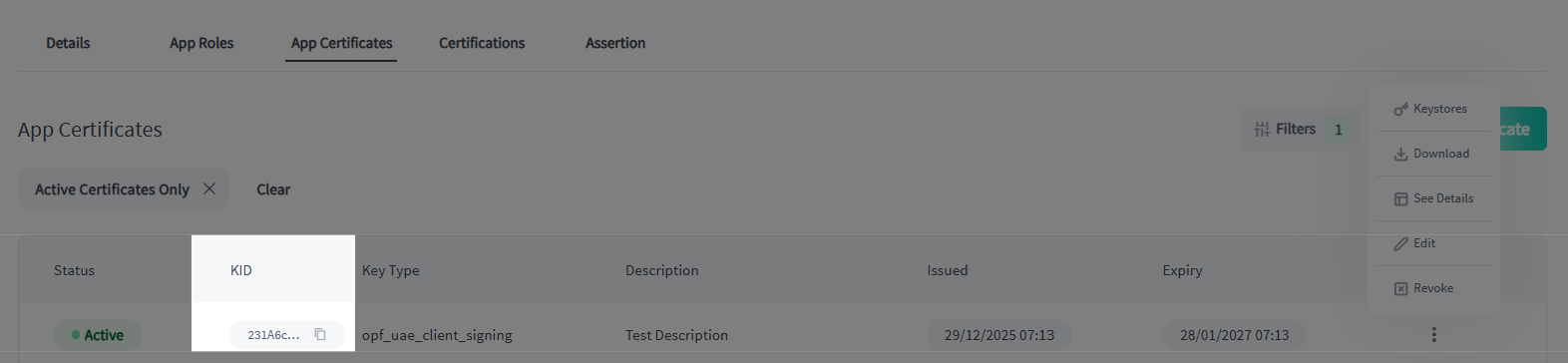
Your kid is always visible on the certificate detail page. Navigate to your Application → App Certificates → select the certificate. Copy the Key ID exactly as shown — it is case-sensitive. See Message Signing for how the kid value is used in the JWT header.
You will need a separate kid for each certificate (Transport and Signing). When signing JWTs, always use the kid of your Signing certificate.